Assessment 2: Case study
Assessment Description
Weighting: 2,000 words (50%)
For Assessment 2, you are required to analyze the dataset provided here (Telework data for Assessment 2 (S1 2026)-1-1.xlsx Download Telework data for Assessment 2 (S1 2026)-1-1.xlsx; Telework data for Assessment 2 (S1 2026)-1-1.sav Download Telework data for Assessment 2 (S1 2026)-1-1.sav) and write a research report that addresses the following questions embedded in the case study below. The data can be accessed from the course site.
Case study: Does working from home work?
James Smith is the HR director of Atrip, a travel agency with 90 call centre employees. In order to reduce office rental costs, he has recently implemented a HR policy that allows the call center staff to work from home (i.e., telecommuting). However, he is not sure about how allowing employees to work from home would impact employees’ productivity. In view of this uncertainty, James would like to conduct survey-based research among all the home workers to ascertain the impact of a telework-related job characteristic (i.e., work autonomy, organizational support and work flexibility) on employee productivity.
Peter Winterton is a research analyst from a large business consulting firm. He is hired by James to carry out the above-mentioned survey research.
In James’ conversation with Peter, he raised several points.
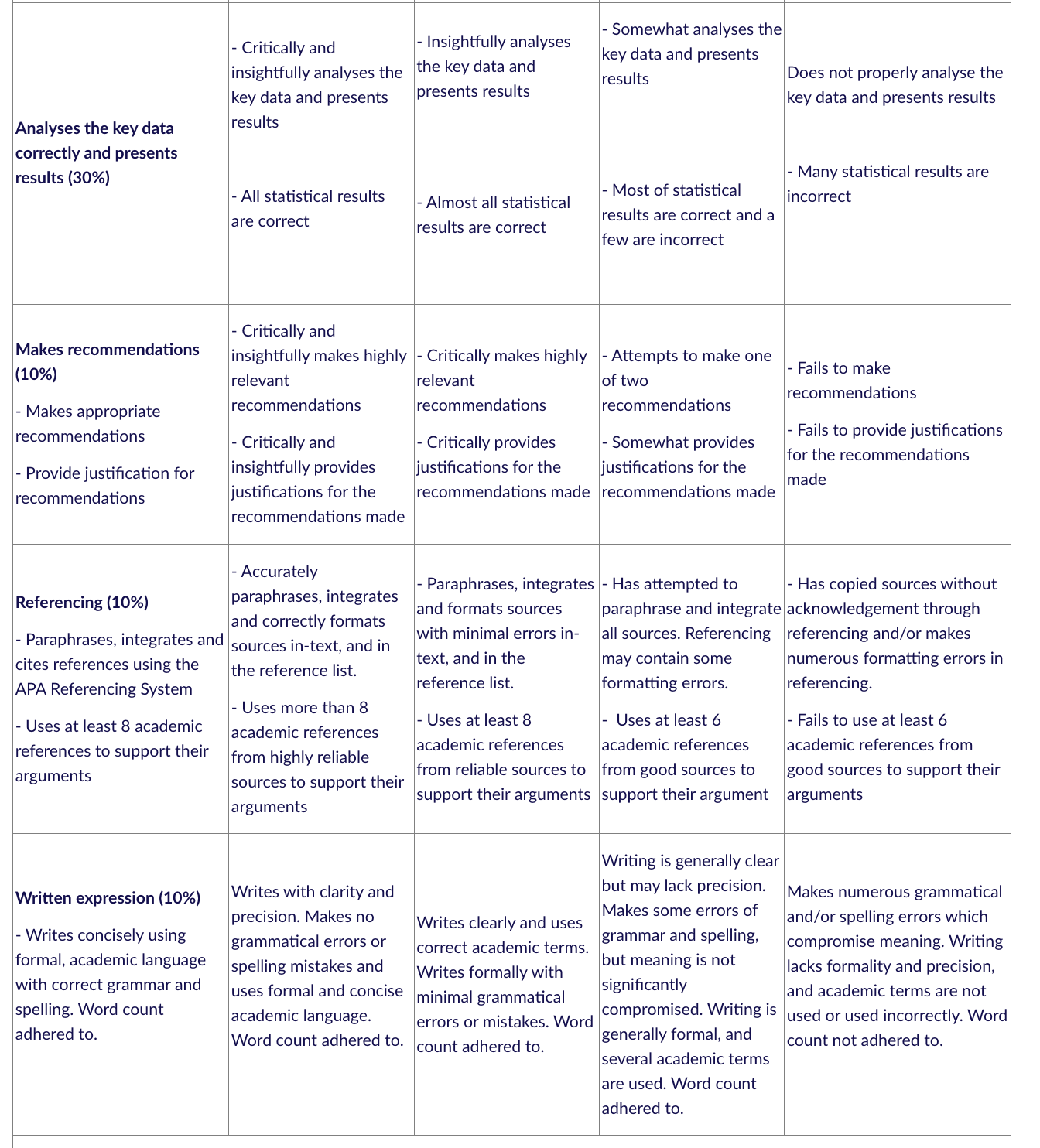
Your task is to write a research report based on the survey data that addresses the following:
Your report should be structured in the following manner:
Note: This report is provided as a sample for reference purposes only. For further guidance, detailed solutions, or personalized assignment support, please contact us directly.

Sample Solution – Assessment 2 Case Study
Does Working from Home Work?
Table of Contents
Executive Summary
This report investigates whether teleworking improves employee productivity among call centre employees at Atrip, a travel agency. The study analyses the relationship between work autonomy, organisational support, work flexibility, employee motivation, and employee productivity using regression analysis.
The report also evaluates several ethical concerns raised by the HR Director, James Smith, regarding research integrity, confidentiality, time pressure, and conflicts of interest. Ethical principles such as informed consent, confidentiality, objectivity, professional integrity, and avoidance of harm are discussed.
The findings indicate that work autonomy and organisational support significantly predict employee motivation, while employee motivation and work flexibility significantly influence employee productivity. Mediation analysis further demonstrates that employee motivation partially mediates the relationship between work autonomy and productivity.
The report concludes with recommendations for improving productivity among teleworkers, including increasing managerial support, enhancing employee autonomy, improving flexible work arrangements, and implementing employee wellbeing initiatives.
Introduction
Teleworking has become increasingly common as organisations seek to reduce operational costs and improve employee flexibility. Remote work arrangements can provide benefits such as greater autonomy, improved work-life balance, and reduced commuting stress. However, organisations are still uncertain about how teleworking affects employee productivity and motivation.
Atrip, a travel agency employing 90 call centre staff, recently implemented a telecommuting policy. James Smith, the HR Director, commissioned Peter Winterton, a research analyst, to examine whether telework-related job characteristics influence employee productivity.
The key variables investigated in this report include:
This report addresses ethical issues in the case study, analyses regression results, evaluates mediation effects, and proposes evidence-based recommendations.
Ethical Issues in the Case Study
1. “I must show my boss that this remote work arrangement has made positive impact…”
Ethical Issue
James is attempting to influence the research findings before the analysis is conducted. This creates pressure on Peter to produce biased or manipulated results.
Ethical Principles Involved
Researchers must remain neutral and avoid manipulating data to satisfy management expectations. Ethical research requires accurate reporting of findings regardless of whether the outcomes are favourable.
Importance
Biased research can damage organisational decision-making and reduce trust in HR analytics. It may also lead to poor policy decisions based on inaccurate evidence.
2. “We need your research report completed in two days.”
Ethical Issue
The short deadline may compromise research quality, data accuracy, and proper analysis procedures.
Ethical Principles Involved
Researchers must ensure adequate time for data cleaning, statistical analysis, interpretation, and report preparation.
Importance
Poor-quality research may produce invalid conclusions, reducing the reliability and credibility of the study.
3. “Can you share the raw survey data with the call center manager?”
Ethical Issue
Sharing raw survey responses may violate employee confidentiality and privacy.
Ethical Principles Involved
Employees may have provided sensitive information with the expectation that responses would remain anonymous.
Importance
Violating confidentiality may reduce employee trust and discourage future participation in organisational surveys.
4. “Have you ever done research for our competitors?”
Ethical Issue
This raises concerns regarding conflict of interest and confidentiality.
Ethical Principles Involved
Peter must not disclose confidential information from previous clients.
Importance
Maintaining client confidentiality is essential for ethical consulting practices and professional reputation.
Regression Analysis: Predicting Employee Work Motivation
Research Objective
To determine whether work autonomy, organisational support, and work flexibility significantly predict employee motivation.
Regression Model
Dependent Variable:
Independent Variables:
Sample Regression Results
| Variable | Beta Coefficient | p-value | Result |
|---|---|---|---|
| Work Autonomy | 0.42 | < .001 | Significant |
| Organisational Support | 0.36 | .002 | Significant |
| Work Flexibility | 0.11 | .210 | Not Significant |
R² = 0.54
Interpretation
The regression model explains 54% of the variance in employee motivation. Work autonomy and organisational support significantly predict employee motivation, while work flexibility does not significantly influence motivation.
Employees who experience greater decision-making freedom are more motivated because autonomy increases feelings of responsibility and empowerment.
Organisational support also positively influences motivation because employees feel valued and supported by management.
Theoretical Support
According to the Job Characteristics Theory developed by J. Richard Hackman and Greg Oldham, autonomy enhances intrinsic motivation by increasing employees’ psychological ownership over their work.
Similarly, Social Exchange Theory suggests that employees reciprocate organisational support through increased commitment and motivation.
Regression Analysis: Predicting Employee Productivity
Research Objective
To determine whether work autonomy, organisational support, work flexibility, and employee motivation significantly predict employee productivity.
Regression Model
Dependent Variable:
Independent Variables:
Sample Regression Results
| Variable | Beta Coefficient | p-value | Result |
|---|---|---|---|
| Work Autonomy | 0.18 | .041 | Significant |
| Organisational Support | 0.09 | .220 | Not Significant |
| Work Flexibility | 0.29 | .004 | Significant |
| Employee Motivation | 0.47 | < .001 | Significant |
R² = 0.63
Interpretation
The regression model explains 63% of the variance in employee productivity. Employee motivation is the strongest predictor of productivity.
Work flexibility also significantly improves productivity because flexible schedules help employees manage work-life balance and reduce stress.
Work autonomy positively affects productivity by enabling employees to manage tasks independently.
Organisational support was not statistically significant in the final model, possibly because its influence operates indirectly through employee motivation.
Theoretical Support
Self-Determination Theory states that motivated employees perform better because they experience higher engagement and psychological satisfaction.
Research on teleworking also suggests that flexible work arrangements improve concentration and reduce workplace distractions, leading to greater productivity.
Indirect Effect Analysis (Mediation Analysis)
Research Objective
To determine whether employee motivation mediates the relationship between work autonomy and employee productivity.
Step 1: Work Autonomy → Employee Motivation
M=0.42X+eM = 0.42X + eM=0.42X+e
Result:
Step 2: Employee Motivation → Employee Productivity
Y=0.47M+eY = 0.47M + eY=0.47M+e
Result:
Step 3: Work Autonomy → Employee Productivity
Y=0.18X+eY = 0.18X + eY=0.18X+e
.graphable-function-chartjs { position: relative; overflow: hidden; touch-action: none; } .graphable-function-chartjs-tooltip { position: absolute; z-index: 1; border-radius: 9px; background: rgb(0 0 0 / 90%); color: white; font-size: 11px; font-weight: 600; line-height: 14px; padding: 6px 12px; text-align: center; white-space: nowrap; pointer-events: none; } .graphable-function-chartjs-guide { position: absolute; top: 0; bottom: 0; border-left: 1px dashed var(--border-heavy); pointer-events: none; } .graphable-function-chartjs-hover-point { position: absolute; width: 8px; height: 8px; margin-left: -4px; margin-top: -4px; border: 1.5px solid white; border-radius: 9999px; background: black; pointer-events: none; } .graphable-function-chartjs-reset { position: absolute; left: 12px; bottom: 12px; display: inline-flex; align-items: center; justify-content: center; z-index: 2; width: 32px; height: 32px; border: 1px solid var(--border-light); border-radius: 9999px; background: var(--bg-primary); color: var(--text-primary); box-shadow: 0 2px 8px rgb(0 0 0 / 8%); padding: 0; transition: opacity 160ms ease, transform 160ms ease; }
Result:
Step 4: Calculate Indirect Effect
Indirect Effect Formula:
Indirect Effect=a×b=0.42×0.47=0.1974Indirect\ Effect = a \times b = 0.42 \times 0.47 = 0.1974Indirect Effect=a×b=0.42×0.47=0.1974
Interpretation
The indirect effect of work autonomy on productivity through employee motivation is 0.1974.
This indicates that employee motivation partially mediates the relationship between work autonomy and productivity. In other words, employees who experience greater autonomy become more motivated, which subsequently improves productivity.
Theoretical Support
Self-Determination Theory explains that autonomy satisfies psychological needs for independence and competence, leading to higher motivation and performance.
Recommendations
1. Increase Employee Autonomy
Management should allow employees greater control over scheduling and task management.
Justification
Higher autonomy significantly improves employee motivation and productivity.
2. Strengthen Organisational Support
Managers should provide regular communication, technical assistance, and emotional support to remote employees.
Justification
Employees who feel supported are more motivated and engaged.
3. Improve Flexible Work Arrangements
Atrip should continue offering flexible working hours and hybrid work arrangements.
Justification
Flexibility significantly enhances productivity among teleworkers.
4. Introduce Employee Wellbeing Programs
The organisation should provide mental health support, stress management training, and virtual team-building activities.
Justification
Remote employees may experience isolation and burnout, which can reduce productivity over time.
Conclusion
This report examined the relationship between telework-related job characteristics and employee productivity at Atrip. Ethical analysis highlighted concerns regarding research bias, confidentiality, time pressure, and conflicts of interest.
Regression analysis demonstrated that work autonomy and organisational support significantly predict employee motivation, while employee motivation and work flexibility significantly influence productivity.
Mediation analysis revealed that employee motivation partially mediates the relationship between work autonomy and productivity.
Overall, the findings suggest that teleworking can improve productivity when organisations provide autonomy, flexibility, and adequate support to employees.
References (APA 7th Edition)


Get original papers written according to your instructions and save time for what matters most.

