
| Due date: | Week8 |
| Group/individual: | Individual |
| Wordcount/Time provided: | 1100 to 1500words |
| Weighting: | 30%(Written) |
| Subject Learning Outcomes: | ULO1ULO2 ULO3&ULO5 |
(PART A)Your case analysis should be written in paragraph form (avoid bullet points unless necessary) and address the following areas:
a) Understanding the Context
Briefly summarise Tesla’s industry context and explain why innovation was critical for the company’s success.
b) Analysis of Innovation
Critically analyze Tesla’s innovation, focusing on:
c) Commercialization Strategy
Evaluate Tesla’s commercialization approach by examining:
d) Challenges and Risks
Discuss the key challenges Tesla faced during commercialization, including:
e) Outcomes and Strategic Impact
Assess the outcomes of Tesla’s innovation strategy in terms of:
f) Managerial Learning
Identify key managerial lessons from the case and explain how these insights can be applied to other organizations or industries.
(PART B) After addressing the above areas in the case study, you need to solve the three case study questions provided in the case study.
Word Length and Formatting
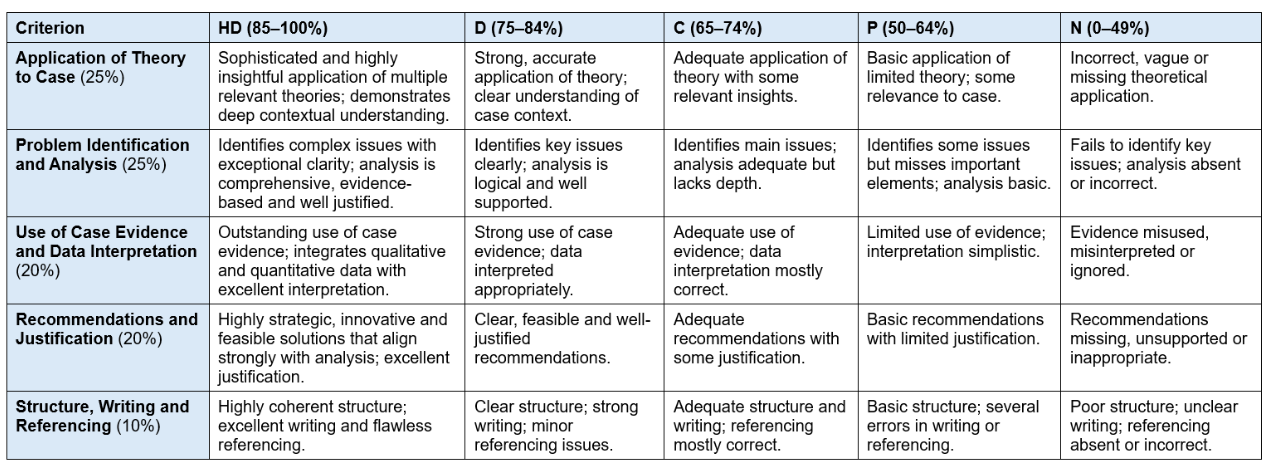
| Criteria | Mar allocation |
| Application of Theory to Case | 25 |
| Problem identification and Analysis | 25 |
| Use of Case Evidence and Data Interpretation | 20 |
| Recommendation and Justification | 20 |
| Structure, Writing and Referencing | 10 |
| Total | 100 |
| Scaledownto | 30Marks |
RUBRIC–Assessment 2 Case Study – Written Report (30%)
Note: This report is provided as a sample for reference purposes only. For further guidance, detailed solutions, or personalized assignment support, please contact us directly.

Subject: ENT902
Assessment: Case Study Report
Tesla operates in the global automotive and clean energy industry, which has traditionally been dominated by large automobile manufacturers such as Toyota, General Motors, and Ford Motor Company. For many decades, the industry relied heavily on internal combustion engine (ICE) vehicles, which use petrol or diesel fuel.
However, increasing environmental concerns, rising fuel prices, and stricter government regulations regarding carbon emissions have created pressure on automakers to transition towards more sustainable transportation solutions. This shift created an opportunity for new companies to introduce innovative alternatives to traditional vehicles.
Tesla was founded in 2003 with the mission of accelerating the world's transition to sustainable energy. Innovation became a critical factor in Tesla’s success because the company entered a highly competitive industry dominated by established players with strong resources and brand recognition. Instead of competing directly with traditional automakers on their existing products, Tesla focused on electric vehicle (EV) technology, battery innovation, and digital integration.
Through continuous innovation in battery performance, software systems, and autonomous driving technology, Tesla positioned itself as a leader in the EV market. The company not only introduced electric cars but also redefined how vehicles are designed, manufactured, and sold.
Tesla’s innovation strategy can be described as disruptive innovation. Disruptive innovation refers to new technologies or business models that significantly change existing markets and challenge established companies.
Tesla disrupted the automotive industry by proving that electric vehicles could be high-performance, technologically advanced, and desirable products, rather than small and low-performance alternatives. The launch of the Tesla Roadster demonstrated that electric cars could compete with luxury sports cars in speed and performance.
Another important aspect of Tesla’s innovation is open innovation. In 2014, Tesla announced that it would open its electric vehicle patents to other companies to accelerate the adoption of EV technology worldwide. This strategy helped promote industry collaboration and encouraged the development of EV ecosystems.
Tesla’s innovation was influenced by both technology push and market pull factors.
Technology push occurred because Tesla invested heavily in battery research, software engineering, and energy storage systems. These technological advancements allowed Tesla to develop vehicles with longer driving ranges and advanced features such as autopilot.
Market pull factors also played an important role. Growing consumer awareness of climate change and increasing demand for environmentally friendly transportation encouraged Tesla to expand its EV product lineup.
Tesla’s approach differed significantly from traditional automakers. Conventional manufacturers usually introduced electric vehicles as secondary products alongside gasoline vehicles. Tesla, however, focused entirely on electric mobility and designed its cars around software, battery systems, and digital integration.
This approach allowed Tesla to deliver features such as over-the-air software updates, which are uncommon in traditional vehicles.
Tesla’s commercialisation strategy played a key role in transforming its technological innovation into market success.
Tesla initially targeted high-income consumers and technology enthusiasts who were willing to pay premium prices for innovative products. Early models such as the Tesla Model S and Tesla Model X were positioned as luxury electric vehicles offering high performance, cutting-edge technology, and environmental benefits.
Tesla’s value proposition focuses on three main aspects:
This combination allowed Tesla to differentiate itself from traditional car manufacturers.
Tesla adopted a premium pricing strategy for its early models to recover high research and development costs and to position the brand as a luxury technology company.
Unlike traditional automakers that rely on dealership networks, Tesla uses a direct-to-consumer distribution model. Customers can purchase vehicles online or through Tesla-owned showrooms. This strategy allows Tesla to control the entire customer experience and maintain consistent brand messaging.
Tesla’s promotion strategy relies heavily on digital marketing, word-of-mouth, and media attention, rather than traditional advertising. The company’s CEO, Elon Musk, has played a significant role in promoting Tesla through social media and public events.
One of Tesla’s most important commercialisation strategies is the development of a comprehensive EV ecosystem.
Tesla invested heavily in building the Tesla Supercharger Network, a global fast-charging infrastructure that allows drivers to recharge vehicles quickly during long trips. This solved one of the major concerns associated with electric vehicles: range anxiety.
Tesla has also developed complementary products such as energy storage systems and solar power solutions, creating a broader sustainable energy ecosystem.
Despite its innovative approach, Tesla faced several significant challenges during the commercialisation of its products.
Developing advanced electric vehicle technology required significant investment in research, manufacturing facilities, and battery production. Tesla experienced several financial difficulties in its early years due to high production costs and limited sales volume.
Large investments in factories, such as the Gigafactory battery production facilities, increased financial risk for the company.
Another challenge was convincing consumers to adopt electric vehicles. Early EVs were often perceived as expensive, unreliable, and limited in driving range. Tesla needed to change these perceptions by demonstrating the reliability and performance of its vehicles.
Additionally, limited charging infrastructure initially made EV adoption more difficult for many consumers.
Tesla also faced intense competition from established automakers and new EV startups. Companies such as Volkswagen Group and BMW have invested heavily in electric mobility to compete with Tesla.
Managing rapid growth, scaling production, and maintaining quality standards created additional organisational challenges for Tesla.
Tesla’s innovation strategy has produced significant outcomes both for the company and for the global automotive industry.
Tesla has become one of the leading electric vehicle manufacturers in the world and has built a strong brand associated with innovation, sustainability, and technology leadership.
Its competitive advantage is based on several factors including advanced battery technology, software integration, and strong brand recognition.
Tesla has accelerated the global transition toward electric mobility. Many traditional automakers have increased investment in EV development as a direct response to Tesla’s success.
The company has also influenced industry trends such as software-based vehicle features and over-the-air updates.
Tesla’s focus on clean energy and electric mobility contributes to reducing greenhouse gas emissions and promoting sustainable transportation.
By popularising electric vehicles, Tesla has played a key role in encouraging governments, businesses, and consumers to support environmentally friendly technologies.
Several important managerial lessons can be learned from Tesla’s innovation strategy.
First, companies should focus on long-term vision and innovation rather than short-term profits when entering emerging markets.
Second, integrating technology, product design, and customer experience can create strong competitive advantages.
Third, developing a supportive ecosystem around a product, such as charging infrastructure, can significantly increase adoption rates.
Finally, leaders should be willing to take calculated risks and challenge traditional industry practices to achieve breakthrough innovation.
These lessons can be applied to many industries, including renewable energy, healthcare technology, and digital services.
Innovation allowed Tesla to differentiate itself from traditional automakers and introduce electric vehicles with superior performance, advanced technology, and environmental benefits. By focusing on battery technology, software integration, and autonomous driving systems, Tesla created a unique market position and built strong brand recognition.
Tesla commercialised its innovation by targeting high-end consumers, using a premium pricing strategy, selling vehicles directly to customers, and building an ecosystem including charging infrastructure. These strategies reduced barriers to EV adoption and strengthened Tesla’s market position.
Tesla faced technological risks, financial challenges, and market adoption barriers. The company managed these risks by continuously investing in research and development, expanding charging infrastructure, and improving product performance to increase consumer confidence in electric vehicles.
Christensen, C. (2016). The Innovator’s Dilemma. Harvard Business Review Press.
Kotler, P. & Keller, K. (2016). Marketing Management. Pearson.
Schilling, M. (2020). Strategic Management of Technological Innovation. McGraw-Hill.
Tesla Inc. (2023). Annual Report.


Get original papers written according to your instructions and save time for what matters most.

